
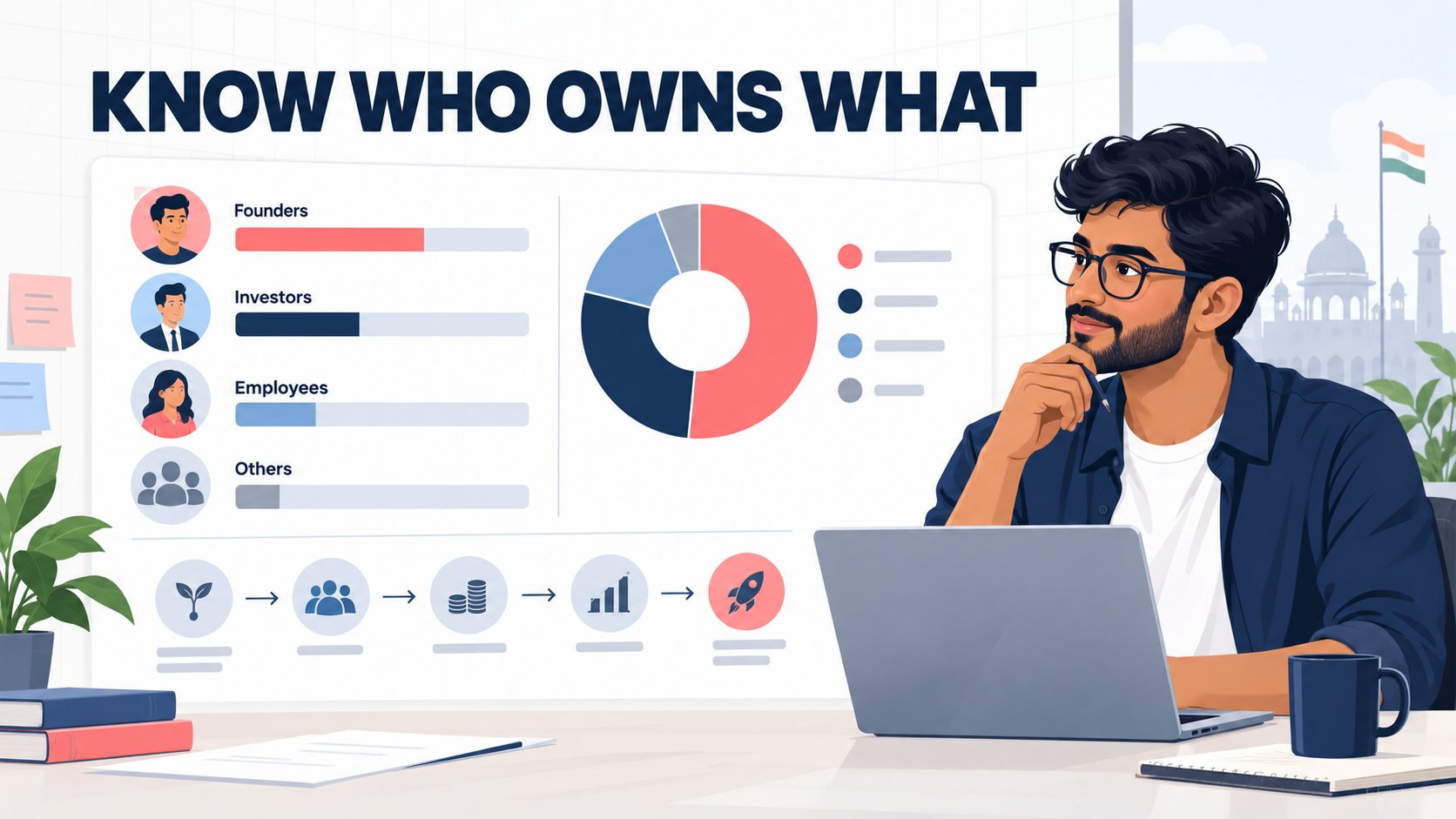
A founder can have a strong product, growing revenue and interested investors, yet lose weeks during fundraising because nobody can confirm who owns what. The spreadsheet says one number, the register of members says another, an early adviser remembers a verbal equity promise, and the ESOP pool has never been reconciled with approved documents.
That is not a cosmetic problem. Ownership affects dilution, voting, investor economics, employee grants and the amount each shareholder may receive in a future transaction. A clean startup cap table cannot make a weak business fundable, but a messy one can create doubt around an otherwise credible company.
This guide explains how Indian founders can build a useful cap table, model a funding round and find errors before an investor does.
What is a startup cap table?
A startup cap table, short for capitalisation table, is a structured record of the securities issued or reserved by a company and the people or entities that hold rights to them. It shows the ownership of founders, investors and employees at a chosen point in time.
At its simplest, it lists each shareholder, security class, number of shares and ownership percentage. A more useful version also tracks options, reserved ESOP shares, preference shares, convertibles and the transaction history behind every change.
For an Indian private limited company, the cap table is a management and modelling tool. It should be reconciled with legal records, not treated as a replacement for them. The Companies Act, 2013 includes requirements relating to the register of members, allotment, transfer and further issue of shares. Founders should have a company secretary or lawyer confirm which approvals, registers, forms and filings apply to a specific transaction.
Why do investors ask for a cap table?
Investors ask for a cap table to understand current ownership, the securities already promised, the dilution created by a proposed round and the people whose consent may matter later. They are also checking whether the numbers in the pitch deck, term sheet, statutory records and financing documents tell the same story.
- How much of the company do the founders still own?
- Is a departed founder carrying a large stake?
- How large is the approved and unallocated ESOP pool?
- Do advisers, employees or early supporters have undocumented promises?
- Are there preference shares, notes or other instruments that could convert?
- What will each stakeholder own after the proposed investment?
- Has the company modelled the effect of a requested ESOP pool top-up?
Investors are not looking only for a tidy file. They are looking for evidence that the founders understand the commitments they have made. That is why fundraising readiness starts with reliable company records and informed ownership decisions, not with a promise of investor access.
What should a startup cap table include?
A working cap table should show both the ownership snapshot and the evidence behind it. The exact fields depend on the company's securities and stage, but the following structure covers most early-stage requirements.
| Field | What it should show | Why it matters |
|---|---|---|
| Holder | Legal name of founder, investor, employee trust or other holder | Prevents confusion caused by nicknames or informal labels |
| Security class | Equity share, preference share, option, warrant or relevant instrument | Different classes may have different economic or voting rights |
| Shares issued | Shares legally issued and outstanding | Forms the current ownership calculation |
| Reserved but ungranted pool | Approved shares kept for future employee grants | Affects the fully diluted view |
| Granted options | Options promised through approved grants, with vesting and exercise status | Shows potential future ownership |
| Issue or grant date | Date of the underlying transaction | Helps match records and approvals |
| Price paid or exercise price | Amount paid for shares or required to exercise an option | Supports transaction review and round history |
| Certificate or distinctive reference | Certificate number or other applicable record reference | Helps reconcile the table with formal records |
| Instrument terms | Conversion cap, discount, interest or maturity where relevant | Determines possible dilution at a future round |
| Source documents | Board or shareholder approval, agreement, allotment filing and register entry | Creates an audit trail for due diligence |
Do not reduce different security classes to a single percentage without retaining the class-level detail. Two holders may each appear to own 5%, yet their voting, conversion, liquidation or other rights may differ under the company's documents.
The cap table should also have a clear as-of date. Ownership is not a timeless fact. It changes when shares are allotted or transferred, options are granted, exercised, cancelled or lapse, a pool is expanded, instruments convert, or a buyback or other approved event occurs.
What is the difference between outstanding and fully diluted ownership?
Outstanding ownership counts shares that have already been issued and remain outstanding. Fully diluted ownership usually adds securities or rights that could become shares, based on the stated assumptions.
Outstanding ownership % = holder's outstanding shares ÷ total outstanding shares × 100
Fully diluted ownership % = holder's shares or as-converted shares ÷ total fully diluted shares × 100
The word "usually" matters. There is no safe universal shortcut for every option, preference share or convertible instrument. The model must state what it assumes about exercise, conversion, unallocated ESOP shares and any conditions attached to securities.
Assume an early-stage company has issued 10,00,000 equity shares: Founder A holds 6,00,000 shares, Founder B holds 4,00,000 shares, and the company has an approved pool of 1,00,000 shares for employee options, all currently unallocated. On an outstanding basis, Founder A owns 60% and Founder B owns 40%. On a simplified fully diluted basis, the denominator becomes 11,00,000 shares after including the reserved pool.
| Holder or reserve | Shares | Fully diluted ownership |
|---|---|---|
| Founder A | 6,00,000 | 54.55% |
| Founder B | 4,00,000 | 36.36% |
| Unallocated ESOP pool | 1,00,000 | 9.09% |
| Total | 11,00,000 | 100% |
Nothing has been transferred from either founder in this illustration. Their percentage is lower because the fully diluted denominator includes the reserved pool. Creating or increasing an option pool dilutes existing holders.
This distinction is one of the first items to label when sharing a cap table. If one founder quotes an outstanding percentage while an investor models a fully diluted percentage, both calculations can be internally correct and still produce a confusing conversation.
How do you build a startup cap table correctly?
Build the cap table from completed transactions and supporting documents, not from memory. Then separate the legal ownership snapshot from assumptions about future conversion or financing.
1. Start with incorporation and founder records. Collect the certificate of incorporation, memorandum and articles, subscriber details, founder agreements, share certificates, board and shareholder minutes, statutory registers and relevant filings. Do not assume the founder split in a pitch deck proves legal ownership.
2. Create a security-by-security transaction ledger. Use one row for each transaction rather than overwriting the latest total. The ownership summary should be generated from this ledger, so it is easy to trace why a holder has a particular balance.
3. Reconcile the ledger with statutory and contractual records. Match every row against source documents: the register of members, share certificates, resolutions, subscription and shareholders' agreements, ESOP documents, grant letters and return-of-allotment records. Investigate differences instead of choosing the version that produces the most convenient percentage.
4. Separate actual, reserved and hypothetical securities. Use distinct sections or clear status labels for issued and outstanding shares, granted but unexercised options, the unallocated ESOP reserve, instruments that may convert, and new securities included only in a funding scenario. An unsigned term sheet is not completed ownership.
5. Add a round history. For every completed funding round, retain the date, amount invested, pre-money and post-money valuation where applicable, price per share, securities issued and supporting agreements. This allows a reviewer to recreate the arithmetic.
6. Add a scenario model without changing the actual table. Keep a locked "current" tab and create separate "pro forma" tabs for proposed rounds. Each scenario should state the investment amount, valuation basis, price per share, new shares, ESOP treatment and conversion assumptions.
How does a funding round change the cap table?
A priced equity round normally adds new shares to the denominator. Existing holders keep the same number of shares unless the transaction includes a transfer, but their ownership percentage falls because the company has more shares outstanding.
Post-money valuation = pre-money valuation + new investment
New investor ownership % = new investment ÷ post-money valuation × 100
Price per share = pre-money valuation ÷ agreed pre-money share count
The phrase "agreed pre-money share count" is important. The term sheet may define the denominator on a fully diluted basis and may require an ESOP pool increase before the investment. Founders should model the term sheet definition rather than inserting only the headline valuation.
Continuing the fully diluted example above: the company has 11,00,000 fully diluted pre-money shares, including its 1,00,000-share ESOP reserve. An investor proposes ₹2 crore at an ₹8 crore pre-money valuation, with no additional pool top-up. Post-money valuation = ₹10 crore; investor ownership = 20%; illustrative price per share ≈ ₹72.73; illustrative new investor shares ≈ 2,75,000.
| Holder or reserve | Shares | Post-round fully diluted ownership |
|---|---|---|
| Founder A | 6,00,000 | 43.64% |
| Founder B | 4,00,000 | 29.09% |
| Unallocated ESOP pool | 1,00,000 | 7.27% |
| New investor | 2,75,000 | 20.00% |
| Total | 13,75,000 | 100% |
The example teaches the mechanics, not the correct legal structure or price for a real transaction. Preference rights, securities premium, fractional-share handling, valuation requirements, foreign investment rules, taxes and filings may change the implementation. Take professional advice before issuing or transferring securities.
How should founders handle an ESOP pool in the cap table?
Show the approved pool, granted options, exercised options, cancelled or lapsed options and remaining unallocated balance separately. Do not use "ESOP 10%" as a floating label with no share count or approval trail.
- How many shares or options were approved?
- How many have been granted?
- Which grants are vested, unvested, exercised, cancelled or lapsed?
- What remains available for new hires?
- Is the percentage measured before or after the next round?
- Who bears dilution if the pool must be increased?
That last question can materially change founder ownership. An investor may ask the company to create or top up a pool before the new money enters. If the increase sits in the pre-money denominator, existing holders may bear more of the dilution. The headline "10% pool" is incomplete unless the term sheet says 10% of what, measured when, and after which securities are included.
A better way to size the pool: build a hiring plan for the period the round is meant to fund. List priority roles, expected grant ranges, hiring dates and a reasonable buffer, then compare the required grants with the unallocated pool. A pool should support the company's hiring plan while keeping the ownership cost visible.
How should convertible instruments appear?
Record each convertible instrument separately with its principal or investment amount, date, conversion trigger, valuation cap, discount, interest, maturity and any other relevant terms. Then model conversion under clearly stated scenarios.
Do not force all convertibles into one estimated share count without retaining instrument-level terms. Two instruments issued at different times may convert at different prices. A priced round can also interact with discounts, caps and accrued amounts in ways that change the result.
For an Indian company, the name used in a fundraising conversation may not fully describe the legal instrument or its regulatory treatment. Confirm the actual documents, eligibility, approvals, pricing rules, foreign investment conditions and filings with qualified advisers. The cap table should mirror the executed instrument, not a generic online template.
What cap table mistakes cause trouble during fundraising?
The most serious errors usually come from incomplete records or undefined assumptions, not difficult arithmetic.
- Verbal equity promises. "1%" can mean 1% at grant, fully diluted, before the next round or after it. Record every promise as a flagged obligation and complete the required approval and documentation promptly.
- Mixing share counts and percentages. Percentages change whenever the denominator changes. Store both, but calculate percentages from the applicable share counts and state the basis.
- Omitting the unallocated option pool. A cap table that shows only granted options can overstate founder ownership in a fully diluted view.
- Treating signed and unsigned documents alike. Separate completed issuances, board-approved grants, signed instruments and proposed terms. Status is as important as amount.
- Ignoring departed founders or employees. Departure does not automatically erase ownership or options. Do not delete a former team member from the cap table simply because they left.
- Failing to reconcile with formal records. A beautiful spreadsheet is still unreliable if it conflicts with the register of members, certificates, approvals or filings.
- Sharing uncontrolled copies. Assign one owner, restrict editing and keep dated exports for review.
- Forgetting rights beyond percentage ownership. Maintain a separate rights summary for voting arrangements, liquidation preference, conversion, anti-dilution, reserved matters, information rights and transfer restrictions.
What will an investor check in a cap table review?
An investor or adviser may test whether the cap table is arithmetically correct, legally supported and consistent with the proposed deal. Founders can prepare by running the same checks internally.
| Review question | Evidence to prepare |
|---|---|
| Do totals add to 100% on the stated basis? | Formula-checked current and fully diluted views |
| Can every issued share be traced? | Register, certificate, approval, payment and filing records as applicable |
| Are option figures credible? | ESOP plan, approvals, grant schedule, vesting and remaining pool |
| Are future claims visible? | Instrument register and scenario conversions |
| Does the pitch deck match the records? | Reconciled founder and investor ownership figures |
| Is the proposed dilution understood? | Pro forma round model and term-sheet assumptions |
| Are there unusual holders or transfers? | Explanations and underlying documents |
Prepare a clean summary for discussion, but keep the detailed transaction ledger and source documents ready in the data room. Do not send sensitive personal data or the full cap table to unverified parties. Share information in stages and control access.
When should a startup update its cap table?
Update the cap table immediately after an approved ownership event and review it at least monthly while grants or fundraising activity are active. It should also be reconciled before a board meeting, investor discussion, financial audit, due diligence exercise or transaction.
- A designated owner records the transaction.
- A second person checks the calculation and document reference.
- The company secretary or legal adviser confirms applicable records and filings.
- The current and fully diluted summaries refresh from the transaction ledger.
- A dated export is saved, with edit access restricted.
Software can reduce formula and version-control errors as complexity grows, but it does not fix poor source documents or unauthorised grants. The right tool is the one your team can keep accurate and reconcile, with suitable security and access control.
How can founders clean up a cap table before fundraising?
Use a short, evidence-led clean-up sprint before outreach becomes active.
Day 1: Freeze and identify the current source. Choose the latest working version, make it read-only and list every competing file. Do not merge data blindly.
Day 2: Collect ownership documents. Gather incorporation records, registers, certificates, approvals, agreements, filings, ESOP records, grants and convertible instruments.
Day 3: Rebuild the transaction ledger. Enter each ownership event in date order. Flag missing documents, unclear status and unmatched figures.
Day 4: Reconcile balances. Compare the ledger totals with statutory records and signed agreements. Ask advisers to resolve legal or filing gaps.
Day 5: Build fully diluted and pro forma views. State assumptions for the ESOP pool, unexercised options, convertibles and proposed round. Test the round arithmetic.
Day 6: Review founder decisions. Check whether the hiring plan supports the pool request, whether the raise size connects to milestones, and whether founders understand post-round ownership.
Day 7: Prepare the investor version. Create a clear dated summary, document its basis and add supporting records to a controlled data room. Keep a list of open items with owners and target resolution dates.
If serious discrepancies appear, delay broad investor outreach until the company understands them. A short pause to establish accurate ownership is usually better than explaining changing numbers during diligence.
Conclusion
A startup cap table is useful when it gives founders a reliable answer to three questions: what ownership exists today, what future claims may dilute it, and what a proposed decision would change.
Build it from source documents, keep actual ownership separate from scenarios, show outstanding and fully diluted bases clearly, and update it after every approved equity event. Most importantly, use it to make better choices about hiring, fundraising amount, valuation, investor terms and founder control.
Need help checking whether your ownership story, business fundamentals and fundraising materials are ready for serious investor conversations? Apply to RaiseMoney Ventures for structured startup support. Applications are reviewed on their merits, and funding or investor introductions are not guaranteed.
This article is for general educational information only. It is not legal, tax, accounting, financial, securities or investment advice. Laws, regulations, filings and transaction terms can change and may apply differently to each company, security and investor. Consult qualified legal, company-secretarial, tax and financial professionals before issuing, transferring, granting, converting or buying back securities.
Frequently asked questions
Is a cap table mandatory for an Indian startup?
"Cap table" is commonly used as a management term. Indian companies have legal obligations relating to members, share capital, allotments, transfers, approvals, registers and filings under applicable law. A cap table should be reconciled with those formal records. Ask a company secretary or lawyer what applies to your company and transaction.
Can a startup use Excel or Google Sheets for its cap table?
Yes, a simple early-stage company can start with a controlled spreadsheet. Use a transaction ledger, locked formulas, dated versions and restricted access. Move to suitable equity-management software when options, multiple security classes, conversions, frequent grants or institutional rounds make manual control risky.
What does fully diluted mean in a cap table?
Fully diluted ownership shows what percentages could look like after including specified securities or rights that may become shares, such as granted options and an unallocated ESOP reserve. The cap table must state its assumptions because different models may treat convertibles and other securities differently.
Does dilution mean founders lose shares?
Not necessarily. In a primary funding round, founders may keep the same number of shares while their percentage falls because the company issues new shares. A transfer or secondary sale is different because an existing holder sells or transfers shares.
Should an unsigned term sheet appear in the cap table?
It should not be shown as completed ownership. Model it in a separate pro forma scenario and label it proposed. Keep the current cap table limited to completed or accurately classified rights and transactions.
How do investors verify a startup cap table?
They may compare it with the register of members, certificates, approvals, filings, subscription agreements, shareholders' agreements, ESOP records, grant letters and convertible instruments. They also test share totals, percentages, price-per-share calculations and proposed dilution.
Who should maintain the startup cap table?
Assign one accountable internal owner, often a founder, finance lead or company secretary, and use a second-person review. Legal and company-secretarial advisers should confirm formal records and compliance. Avoid several people maintaining separate master copies.