
Founders often respond to slow investor interest by rewriting the deck, adding introductions or increasing the amount they want to raise. Those actions do not fix the usual underlying problem: the business case is not yet supported by enough evidence.
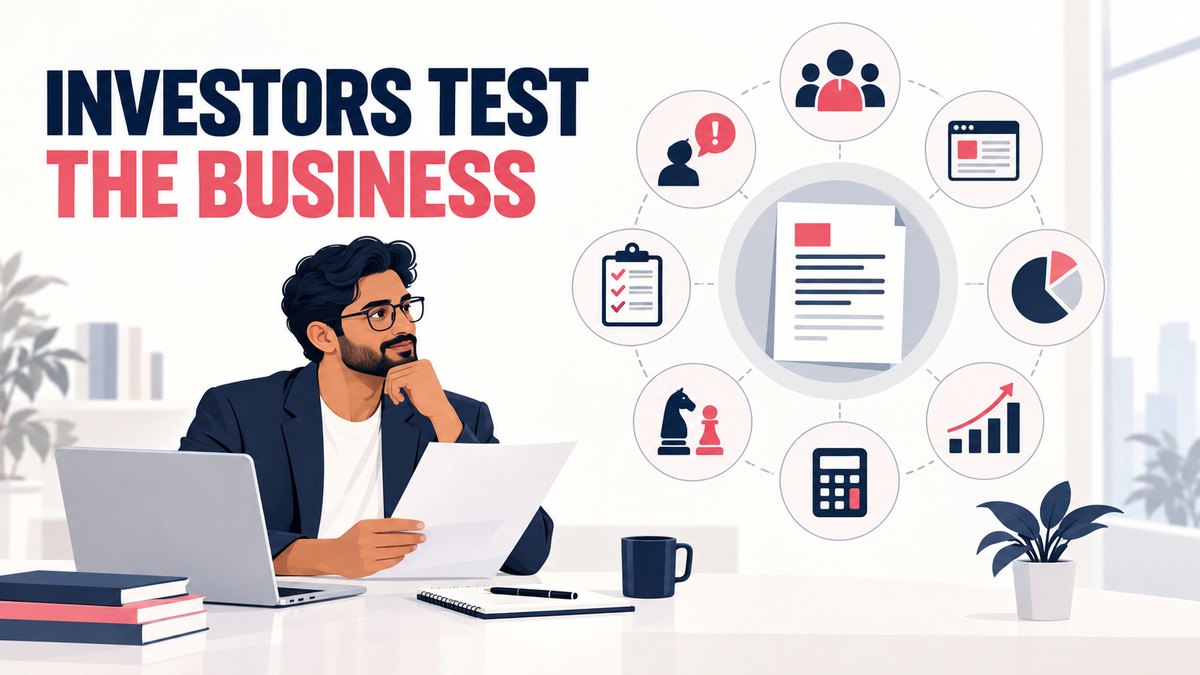
Investors do not assess the pitch in isolation. They assess whether the founders can build, whether customers care, whether the market can support meaningful growth, whether the economics can improve and whether the proposed round buys a valuable milestone. The deck only organises that case.
What do investors look for in a startup?
Investors generally look for eight connected signals: a capable and committed team, a painful customer problem, a credible product, a large reachable market, stage-appropriate traction, workable economics, a defendable position and clean fundraising readiness. The weight of each signal changes by stage, sector and investor strategy.
An idea-stage startup may not have revenue, but it can show founder-market fit, customer interviews, a sharp problem definition and fast execution. A seed-stage company claiming repeatable growth should have cohort, revenue, retention and acquisition data. The more mature the claim, the stronger the proof should be.
This is also why a rejection does not always mean the startup is poor. A good business may not fit a particular fund's sector, geography, stage, cheque size, ownership target or time horizon. Founders should test both business readiness and investor fit.
Test 1: Is the founding team suited to this problem?
Early-stage investing contains substantial execution risk, so investors study who will make thousands of decisions after the cheque is written. They want more than polished biographies. They look for evidence that the founders understand the problem, can attract the required skills, move quickly, learn from customers and work through difficult trade-offs.
The most useful concept is founder-market fit: the reason this team has a credible advantage in understanding or solving this problem. That advantage may come from years in the industry, technical research, lived experience, a trusted distribution network or unusually deep customer access.
Founders should be ready to explain:
- Why did you choose this problem before it became a fundraising story?
- Which insight do you have that a smart outsider may miss?
- What has each founder built, sold or learned so far?
- How are roles and major decisions divided?
- Are all founders committed full-time, and if not, what is the transition plan?
- Which critical capability is missing, and how will you add it?
The best proof is behaviour. A founder who ran 60 structured customer conversations, built an initial product and changed direction after contrary evidence shows learning speed. A slide calling the team "visionary" proves nothing.
Y Combinator's discussion of strong founders highlights communication, execution and motivation. Those qualities become visible through concise answers, consistent data and the pace at which the team converts learning into progress, not through adjectives in a pitch. See YC's founder evaluation discussion. A solo founder should address key-person risk and missing skills directly rather than adding a co-founder only for appearances.
Test 2: Is the customer problem painful and specific?
A startup does not become investible because its product is technically interesting. Investors need to understand who experiences the problem, when it occurs, what it costs and why the current alternative is inadequate.
Startup India's official investor guidance begins with objective and problem solving, while its funding guidance lists factors such as revenue growth, market position and return potential. Together, those points reinforce a practical sequence: define a real customer need first, then prove that solving it can become a valuable business. See Startup India's investor-engagement guidance and its funding-readiness guidance.
A precise problem statement should include four parts: the customer who has the problem, the trigger that creates it, the cost in money, time, risk or lost opportunity, and the alternative the customer uses today.
For example, "small businesses struggle with payments" is too broad. "Independent clinics in tier-two Indian cities lose staff time reconciling UPI, cash and insurer payments across separate records" is testable. A founder can interview clinic owners, observe the workflow, estimate reconciliation time and identify who controls the software budget.
Evidence may include interview notes, support requests, signed pilot agreements, repeated workflow observations, search demand, customer deposits or usage of a manual prototype. Treat letters of intent carefully. A non-binding expression of interest is weaker than a customer investing time, sharing data, changing a workflow or paying.
Test 3: Does the product create measurable customer value?
At idea stage, investors may assess the insight and the team's ability to build. Once a minimum viable product exists, the question changes: does the product create enough value for customers to adopt it, use it and return?
Avoid presenting a feature list as product evidence. Connect each important feature to a customer outcome. If a logistics product reduces planning time, show the old and new workflow. If a consumer app promises convenience, show activation and repeat behaviour. If a climate-tech product requires hardware deployment, show test results, cost assumptions and the path from pilot to reliable production.
Useful evidence includes:
- A working demo using a normal customer scenario
- Activation data tied to a defined first-value event
- Repeat usage or retention by customer cohort
- Conversion from trial or pilot to paid use
- Customer references that describe a concrete outcome
- A product roadmap linked to adoption barriers, not founder preferences
- Known technical, regulatory or supply risks and the plan to reduce them
Sequoia's product-market-fit framework starts with how the customer relates to the problem and distinguishes urgent demand from problems that require behaviour change or belief in a new future. This matters because the same usage result can mean different things. See Sequoia's product-market-fit framework.
Product-market fit is not a certificate or one metric. It is a pattern in which a defined customer group repeatedly chooses the product and receives value. Pre-seed founders do not need to claim it prematurely. "We have evidence of demand, but retention across larger cohorts is the next risk" is more credible than a grand conclusion based on a few friendly users.
Test 4: Is the market large, reachable and well understood?
Investors need to believe the company can become large enough for their investment model. A large sector report alone does not prove that. The founder must connect market demand to a specific customer, price, buying process and practical route to reach that customer.
Build market sizing in three layers:
| Layer | Founder question | Useful evidence |
|---|---|---|
| TAM | What is the total demand if the broad market is served? | Credible customer count multiplied by relevant annual spend |
| SAM | Which part can this product and business model serve? | Geography, segment, regulation, channel and product limits |
| SOM | What can the startup reasonably capture in a defined period? | Sales capacity, conversion, pricing and competitive assumptions |
Annual market opportunity = number of target customers × average annual revenue per customer
Suppose a founder targets 20,000 eligible businesses and expects an average annual contract value of ₹60,000. The calculated opportunity is ₹120 crore. That is not automatically the startup's revenue forecast. The founder must still validate the customer count, willingness to pay, sales capacity, churn and time needed to win accounts.
Sequoia's presentation guidance recommends explaining customer count, how it changes and the value of each customer, and cautions against displaying a huge market-study number without the assumptions beneath it. It also advises founders to identify competitors before investors discover them independently. See Sequoia's guidance on presenting to investors.
For Indian startups, reachable market analysis should account for language, city tier, payment behaviour, procurement cycles, channel economics, regulation and service costs where relevant. "India has a large population" is not a go-to-market plan.
Test 5: Is traction real, relevant and repeatable?
Traction is evidence that the startup has reduced an important risk. Revenue is valuable, but it is not the only form. The right proof depends on stage and business model.
| Stage | What investors may reasonably examine |
|---|---|
| Idea or research | Customer discovery quality, prototype progress, technical feasibility, founder speed |
| Validation or MVP | Activation, pilots, usage frequency, early retention, customer feedback |
| Early revenue | Revenue quality, growth, gross margin, churn, sales cycle, repeat purchase |
| Seed growth | Cohort retention, acquisition efficiency, contribution margin, expansion and forecast accuracy |
Vanity metrics hide more than they reveal. Total app downloads may look impressive while active use is falling. Gross merchandise value can grow while contribution margin worsens. Signed pilots may not convert to paid deployments. Investors usually ask what happened by cohort, channel, customer type and period.
Prepare a metric dictionary that defines every number: monthly growth rate = (current month's value − previous month's value) ÷ previous month's value × 100; gross margin = (revenue − direct cost of delivering the product) ÷ revenue × 100; monthly burn = cash operating outflows − cash operating inflows for the month; runway in months = available cash ÷ expected monthly burn.
Use the formulas consistently and show raw figures behind percentages. If revenue rose from ₹4 lakh to ₹6 lakh in one month, the 50% growth rate is mathematically correct but not yet proof of a repeatable engine. Investors will ask what caused the increase, whether customers stayed and whether the channel can scale.
Test 6: Can the business model produce attractive economics?
A growing startup can still destroy value if each sale creates an increasing loss with no credible path to improvement. Investors therefore examine how the company earns revenue, what it costs to serve customers and what must become true for growth to create economic value.
Founders should understand pricing, gross margin, customer acquisition cost, contribution margin, working-capital needs, sales payback, churn and capital intensity as relevant to their model. A marketplace, SaaS company, consumer brand and manufacturing startup should not be judged through identical metrics.
Consider a hypothetical B2B software startup charging ₹1.2 lakh per customer per year. If direct cloud and support costs are ₹24,000 per customer, gross profit is ₹96,000 and gross margin is 80%. If sales and onboarding cost ₹72,000 for each new customer, the founder should explain how long the customer stays, when that acquisition cost is recovered and how the figures change by channel.
The point is not to present perfect economics at an early stage. It is to show that the founders know which variables control the model and are running tests to improve them. "We will reduce costs at scale" is an assumption. Vendor quotes, process changes, repeatable sales data and improving cohort results are evidence.
Test 7: Does the startup have a credible right to win?
Investors expect competition because valuable problems attract alternatives. Saying "we have no competitors" usually means the founder has defined the market too narrowly or ignored the customer's current workaround.
Map direct competitors, indirect alternatives and the status quo. Then explain why a defined customer will choose your product and why that advantage can strengthen. A defendable position may come from distribution, data rights, regulated approvals, workflow integration, switching costs, community, brand trust, cost structure, intellectual property or operating speed. A feature that another team can copy in a week is not a durable defence by itself.
Ask three questions: why do customers choose us now, what becomes harder to copy as we grow, and what evidence would prove our advantage is not temporary?
Public investment memos show that investors do not write only about upside. Bessemer Venture Partners' published Twitch memo covers value proposition, market, product, metrics, risks, team, deal and scenarios. The company was specific, but the structure illustrates a wider habit: investment decisions compare evidence with unresolved risk. See Bessemer's public Twitch investment memo.
Test 8: Is the round and the company ready for investment?
An investor-ready business needs a clear reason to raise, not merely a target amount. The founder should state which milestone the capital will fund, how long the plan takes, what assumptions could change and why the next milestone increases the company's options.
For example, "We are raising ₹2 crore for 18 months" is incomplete. A better explanation connects spending to results: "The round funds product reliability, six paid enterprise deployments and validation of a repeatable sales motion. We have separated committed hires from hires triggered by customer conversion." The actual milestone must suit the company; it should not be copied from another pitch.
Investors may also review the cap table, incorporation records, statutory filings, founder agreements, intellectual-property ownership, material contracts, financial statements and data accuracy. Clean records do not make a weak business strong, but disorder can delay or end interest in a promising one.
Finally, test investor fit before outreach:
- Does the investor fund this stage and sector?
- Is the proposed cheque within its usual range?
- Does it invest in India or the company's operating geography?
- Are there portfolio conflicts worth discussing?
- Can it participate in later rounds if that matters?
- Does its decision timeline match the startup's runway?
- What ownership, governance or information rights may it expect?
Investor access is useful only when the business and the investor make sense for each other. A long contact list cannot repair a vague milestone or unreliable data.
How do investor expectations change by startup stage?
The evaluation categories remain similar, but the acceptable proof changes.
Idea stage. Investors assess insight, team quality, market potential and speed of learning. Prepare a clear problem thesis, interview evidence, an early prototype and a validation milestone. Revenue projections are assumptions, not traction.
Pre-seed stage. Investors may expect a working product or credible build progress, early user behaviour, pilots and a sharper initial customer. The round should reduce a specific product, demand or distribution risk.
Seed stage. A company claiming momentum should show stronger cohorts, revenue quality, retention and a repeatable acquisition hypothesis. Investors will test whether growth comes from durable demand or one-off deals.
Capital-intensive or regulated startup. Deep-tech, healthcare, fintech, mobility and manufacturing companies often have longer validation cycles. The right evidence may be technical milestones, approvals, production risk, partnerships and capital planning rather than software-style revenue patterns.
What should a founder include in an investor evidence pack?
Build a compact evidence pack before sending many messages. It should contain a concise deck, a metric sheet with definitions, customer and market evidence, a scenario-based financial model, a milestone-linked use-of-funds plan, the current cap table and an index of diligence documents. Protect sensitive information and open a controlled data room only when appropriate.
Consistency is the first test. The monthly recurring revenue in the deck, metric sheet and model should match. If they do not, record why, correct the source and update all versions before outreach.
How can founders score their readiness without pretending it is precise?
Use a simple red-amber-green review. It is a preparation tool, not an investment prediction.
| Area | Green | Amber | Red |
|---|---|---|---|
| Team | Roles and relevant proof are clear | One material skill or commitment gap | Ownership or commitment conflict is unresolved |
| Problem | Repeated evidence from a defined customer | Pain is plausible but evidence is thin | Customer and problem keep changing without learning |
| Product | Users reach a measurable outcome | Product works but repeat value is unclear | Demo or claims cannot be verified |
| Market | Bottom-up case with sourced assumptions | Broad opportunity, weak reachable-market logic | Top-down number with no customer path |
| Traction | Defined metrics show useful progress | Early signal, short history or noisy cohorts | Vanity figures or inconsistent data |
| Economics | Key drivers and experiments are understood | Major assumptions remain untested | Founder cannot explain cost or revenue drivers |
| Defence | Clear choice reason that can strengthen | Differentiation exists but is easy to copy | Competition is dismissed |
| Readiness | Milestone, amount, records and fit are clear | Pack has fixable gaps | No use-of-funds logic or material record issues |
Do not average away a critical red area. A serious founder dispute, unreliable numbers or unclear intellectual-property ownership may matter more than several green rows. Resolve material problems before increasing outreach volume.
Example: how an Indian B2B founder can turn claims into evidence
Hypothetical example: A Bengaluru startup helps small diagnostic labs manage sample pickups from local clinics. It plans to raise ₹1.5 crore.
Its first pitch says, "India's diagnostics opportunity is huge, labs love our platform and we have no direct competition." Investors struggle to assess this because the claims are broad. The founder rebuilds the case:
- Problem: Interview notes show that lab managers lose visibility when pickup schedules change across phone calls and messaging groups.
- Product: A working dispatch tool records pickup status and exception reasons.
- Traction: Eight labs completed pilots; five converted to paid contracts. The founder separates active locations from signed locations.
- Customer value: Pilot reports compare missed-pickup rates and coordinator time before and after adoption, using customer-approved data.
- Market: The initial calculation counts labs in two target cities that meet specific size and workflow criteria, multiplied by a tested annual price.
- Economics: The model separates onboarding cost, field support and software delivery cost. It does not assume support disappears at scale.
- Competition: The comparison includes general logistics tools, in-house coordinators and the existing phone-and-spreadsheet process.
- Round: The ₹1.5 crore plan funds defined product integrations, a controlled expansion into one additional city and validation of sales payback.
The startup has not become certain to raise capital. It has become easier to evaluate because each statement points to evidence, assumptions are labelled and the round has a purpose.
What mistakes make investors lose confidence?
The most damaging mistakes are usually avoidable:
- Starting outreach before resolving contradictions. Different revenue, market or fundraising numbers across documents create doubt.
- Confusing activity with traction. Meetings, followers, downloads and registrations matter only when they connect to customer value or a defined funnel.
- Using a giant market number as proof. A founder must show the reachable segment and route to revenue.
- Claiming there is no competition. Every customer already uses an alternative, even if that alternative is manual work.
- Hiding bad data. Explain churn, delayed pilots or a missed target, then show what changed.
- Forecasting without drivers. Revenue should follow customer count, price, conversion, capacity and timing assumptions.
- Targeting every investor. Poor fit wastes runway and produces misleading feedback.
- Treating funding as the milestone. The real milestone is the product, customer or operating result bought by the capital.
How can a founder improve investor readiness in 30 days?
Start with the weakest evidence, not the prettiest slide.
Days 1 to 7: Reconcile revenue, cash, burn, customers, usage and cap-table data. Define every pitch metric.
Days 8 to 14: Interview the target segment, review lost deals and rebuild market sizing from customer count and price. Record contrary evidence too.
Days 15 to 21: Link monthly spending and hiring gates to the operating milestone that should make the company stronger.
Days 22 to 26: Audit the deck, metric sheet, model and document index. Ask a trusted operator to challenge the assumptions.
Days 27 to 30: Build the investor-fit list using stage, sector, geography, cheque range, conflicts and reason for fit.
If the work exposes a weak retention pattern, unresolved founder issue or untested customer need, pausing broad outreach may be the best result. Fixing the business case protects time, reputation and negotiating position.
Conclusion
What investors look for in a startup is not one magic metric. They look for a connected case: the right team is solving a meaningful problem with a useful product in a reachable market, traction reduces key risks, the economics can support growth, the position can strengthen and the proposed capital funds a worthwhile milestone.
A founder cannot control an investor's strategy or decision. A founder can control the quality of the evidence, the accuracy of the numbers, the honesty of the risks and the discipline of investor selection. That is the work that makes a startup more fundraising-ready, whether the next meeting comes through a warm introduction or a cold email.
This article provides general educational information for startup founders. It is not legal, tax, securities, financial or investment advice, and it does not guarantee funding or investor interest. Consult qualified legal, tax and financial professionals before making fundraising or investment decisions.
Frequently asked questions
What is the most important thing investors look for in a startup?
There is no universal single factor, but early-stage investors often place heavy weight on the founding team, the customer problem and the size of the opportunity. As the startup matures, product usage, retention, revenue quality and economics usually carry more weight. The evidence should match the company's stage and claims.
Do investors fund startups without revenue?
Yes, some investors fund pre-revenue startups when their strategy includes idea or pre-seed opportunities. Such founders still need evidence, such as domain insight, customer discovery, technical progress, a credible team and a clear validation plan. Other investors require revenue, so stage fit matters.
How much traction do investors expect before funding?
There is no standard number across sectors and stages. A consumer app, enterprise software company and medical-device startup have different development and adoption cycles. Founders should identify the risk their stage is meant to have reduced and present the most relevant usage, customer, technical or commercial evidence.
What numbers should founders know in an investor meeting?
Founders should know revenue, growth, gross margin, cash, burn, runway and customer counts, plus business-model-specific metrics such as retention, churn, acquisition cost, repeat purchase, sales cycle or contribution margin. They should also be able to define each metric and explain the raw figures behind it.
Is a strong pitch deck enough to get startup funding?
No. A strong deck makes the business easier to understand, but it cannot replace customer evidence, product quality, reliable metrics, sensible economics or clean records. Investors may use the deck to choose which questions to ask, then verify the answers during meetings and diligence.
Why do investors reject good startups?
A rejection may reflect fund fit, timing, sector conviction, cheque size, ownership targets, portfolio conflicts, risk tolerance or the strength of competing opportunities. Founders should ask for specific feedback where appropriate, look for repeated patterns and avoid rebuilding the company around one investor's opinion.
How should founders choose which investors to contact?
Filter investors by stage, sector, geography, cheque size, portfolio conflicts and ability to support the planned round. Then assess reputation, decision process, governance expectations and potential value beyond capital. A smaller, well-researched list is usually more useful than untargeted outreach.