
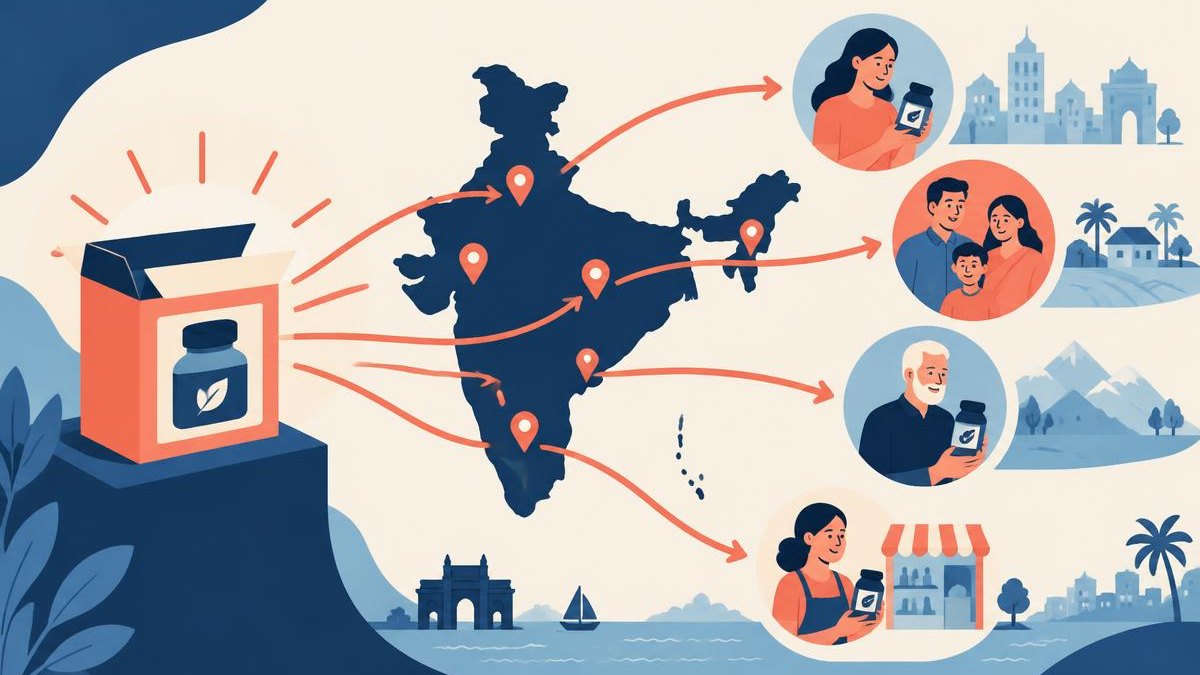
A go-to-market strategy is the plan by which a startup takes a validated product to its first paying customers and then to repeatable revenue. Many early-stage founders in India treat go-to-market as a marketing checklist: a website, a few social posts, perhaps a paid campaign. In practice, go-to-market is a sequencing decision. It determines which customer segment to approach first, which channel to use, how to price, and what signals indicate that the approach is working or needs to change.
This guide sets out a structured approach to go-to-market for founders who have completed basic idea validation and are preparing to acquire their first customers. It assumes limited budget, a small team, and the need to learn quickly rather than spend heavily.
Why go-to-market should follow product-market fit signals, not precede them
A common sequencing error is to invest in broad marketing before there is any evidence of product-market fit. Spending on paid acquisition for a product that customers do not yet value simply accelerates the rate at which money is spent without return. The more defensible sequence is: validate the problem, build a minimum product, sell it manually to a small number of customers, observe what makes them renew or refer others, and only then design a repeatable go-to-market motion around that signal.
Founders who have not yet reached this point should first read the guide to MVP development for startups, since go-to-market decisions made before the product is ready tend to be discarded within a few months.
How do you choose the right go-to-market channel for an Indian startup?
There is no universally correct channel. The right choice depends on who the customer is, how they currently solve the problem, and how much the startup can afford to spend to acquire one customer relative to what that customer is worth over time. Founders should evaluate channels against a small number of criteria before committing meaningful time or budget.
| Channel | Typical fit | Key risk |
|---|---|---|
| Founder-led outbound sales | B2B, high-value accounts, early stage | Does not scale without a sales process |
| Content and SEO | Products with searchable problems | Slow to show results, needs months of consistency |
| Paid performance marketing | Clear unit economics, repeatable funnel | Expensive without a proven conversion path |
| Partnerships and channel resale | B2B products that fit into an existing workflow | Dependent on partner's priorities |
| Community and referral | Products with a strong user community | Hard to manufacture if not organic |
What role does founder-led sales play before hiring a sales team?
For most B2B and several B2C startups, the founder is the first and best salesperson. Founder-led sales allows the team to learn objections, refine messaging and understand buying triggers directly, rather than through a layer of hired staff who may not yet have the full picture. A useful discipline is to run a small number of paid pilots before building a scaled go-to-market motion, since a customer who pays, even a modest amount, provides a far stronger signal than one who merely agrees to try the product for free.
HYPOTHETICAL example: sequencing a go-to-market plan for a B2B SaaS startup
The following figures are illustrative only and do not represent any actual RaiseMoney portfolio company. Assume an early-stage B2B SaaS startup selling an invoicing tool to small retailers, with a monthly subscription price of ₹2,000 per customer.
In month one, the founders run 20 manual outbound conversations and close 4 paying pilot customers, generating ₹8,000 in monthly recurring revenue (4 x ₹2,000). In month two, having learned which objections recur, they refine the pitch and close 10 of 40 outbound conversations, adding ₹20,000 in new monthly recurring revenue, for a cumulative ₹28,000. If customer acquisition cost through outbound effort is estimated at roughly ₹3,000 per customer (founder time and basic tools) and the average customer stays 18 months, the approximate lifetime value per customer is ₹36,000 (₹2,000 x 18), giving a lifetime-value-to-acquisition-cost ratio of about 12:1. This ratio, not the total revenue figure alone, is what should guide whether to scale the channel or add a second one.
How should pricing fit into a go-to-market plan?
Pricing is not a separate exercise from go-to-market; it is one of the levers that determines which channel is viable. A product priced too low may not sustain a paid acquisition channel, since the cost of acquiring a customer can exceed what that customer ever pays. A product priced too high for the segment may need a longer, consultative sales cycle rather than a high-volume self-serve channel. Founders should test pricing with a small number of real customers before finalising the broader go-to-market motion.
Go-to-market checklist before scaling spend
Before increasing budget on any channel, founders should confirm the following:
- At least 5 to 10 paying customers acquired through the channel being considered for scale
- A documented reason why customers bought, based on direct conversations, not assumptions
- A customer acquisition cost that is clearly lower than the expected customer lifetime value
- A repeatable script, message or process that does not depend solely on one founder's personal relationships
- A basic method to track where each customer came from
- Confirmation that the product can currently support more customers without breaking
How does go-to-market connect to fundraising readiness?
Investors evaluating an early-stage company will ask how the company intends to acquire customers profitably, and whether early traction reflects a repeatable motion or one-off effort. A credible go-to-market narrative, supported by a small amount of real data, forms part of investor readiness. It is also one of the elements examined during due diligence, since investors are wary of growth that cannot be explained or repeated.
Founders preparing for a fundraise should also review how to pitch to investors for guidance on presenting go-to-market plans credibly, without overstating what has actually been proven.
How RaiseMoney supports go-to-market planning
Go-to-market strategy is one of the eight pillars covered in the RaiseMoney incubation programme, alongside idea validation, product development and investor preparation. Founders work with mentors to design a channel sequence suited to their specific product and budget, rather than adopting a generic playbook. Interested founders can apply to the programme to be evaluated for the current cohort.
Sources
Startup India, official Government of India portal for startup policy and schemes, reviewed 4 October 2026.
Atal Innovation Mission, official Government of India portal, reviewed 4 October 2026.
This guide is for general educational purposes and does not constitute business, legal or financial advice. Founders should assess their own circumstances or consult a qualified professional before acting.
Founders seeking structured support in building and testing a go-to-market plan can apply to RaiseMoney's incubation programme.
Frequently asked questions
What is a go-to-market strategy for a startup?
A go-to-market strategy is a plan describing which customer segment a startup will target first, which channel it will use to reach them, how the product will be priced, and how early signals will determine whether to continue or adjust the approach.
How do I choose a go-to-market channel with a small budget?
Start with founder-led outreach or a narrow, low-cost channel such as content or community engagement. Avoid paid acquisition until you have clear evidence of what makes customers buy and stay, since untested paid spend is the fastest way to exhaust limited funds.
Should I hire a sales team before I have paying customers?
Generally no. Founders should close the first several customers themselves to learn objections and refine the pitch. A sales team hired before this learning happens often repeats the same avoidable mistakes at greater cost.
How many customers do I need before scaling my go-to-market channel?
There is no fixed number, but most founders should aim for at least 5 to 10 paying customers acquired through a channel, with a documented and repeatable reason for why they bought, before committing significant budget to scale it.
What is customer acquisition cost and why does it matter?
Customer acquisition cost is the total cost of acquiring one paying customer through a given channel. It matters because a channel is only viable if this cost is meaningfully lower than the revenue expected from that customer over their lifetime.
How does go-to-market strategy affect fundraising?
Investors assess whether a startup's early growth reflects a repeatable, explainable process or one-off effort. A credible go-to-market plan backed by real data strengthens a fundraising pitch and is examined during due diligence.