
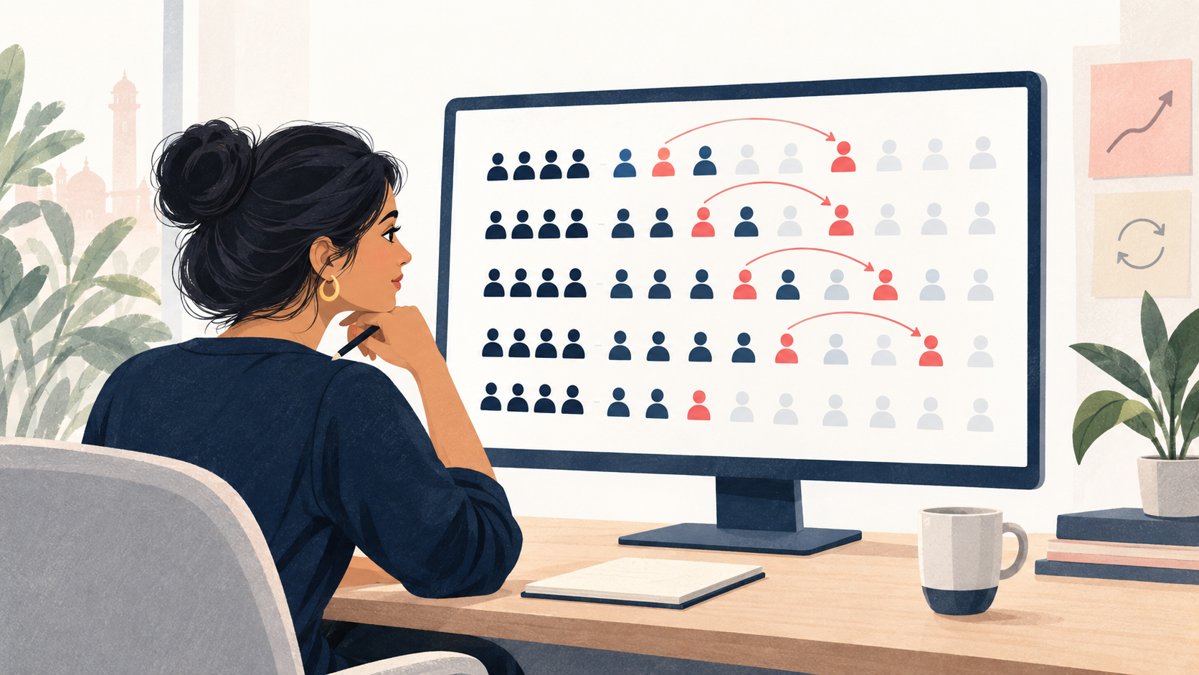
Customer retention measures how effectively a startup keeps existing customers engaged, satisfied and willing to purchase again. Strong retention strategies include improving customer onboarding, collecting feedback, personalising experiences, analysing customer behaviour and addressing churn early. By tracking customer retention rate, churn rate, cohort performance and revenue retention, founders can understand whether their product delivers lasting value and whether their business is ready to scale.
What Is Customer Retention in a Startup?
Startup customer retention refers to a company's ability to keep existing customers engaged with its product or service over a defined period. It measures whether customers continue using, purchasing or renewing after their first interaction.
For an early-stage startup, acquiring customers is only half the challenge. The real test is whether those customers find enough value to return. For example, a SaaS startup may attract 500 users through a marketing campaign. However, if most users stop using the platform after their first month, increasing acquisition spending will not solve the underlying problem.
Customer retention helps founders understand three important things:
- Whether customers are receiving consistent value.
- Whether the product solves a recurring problem.
- Whether the business can generate repeatable revenue.
Retention also provides useful evidence when evaluating product-market fit and preparing for fundraising.
Why Is Customer Retention Important for Startups?
Customer retention directly influences revenue stability, profitability and long-term business growth.
Here are five reasons startups should prioritise it:
1. Reduces customer acquisition pressure:Retaining existing customers reduces the constant need to replace customers who leave.
2. Improves revenue predictability:Repeat purchases, renewals and subscriptions help businesses forecast future revenue more confidently.
3. Builds customer lifetime value (LTV):Customers who stay longer can generate more revenue over their relationship with the business.
4. Creates organic growth opportunities:Satisfied customers are more likely to recommend products, provide referrals and share positive experiences.
5. Strengthens investor confidence:Consistent retention can demonstrate that customers receive genuine value rather than purchasing only because of discounts or promotions.
However, high retention alone does not guarantee profitability. Founders must also understand acquisition costs, servicing expenses and contribution margins.
Related reading:Understand startup unit economics, customer lifetime value and CAC payback.
How Do You Calculate Customer Retention Rate?
Customer retention rate measures the percentage of customers from an existing customer base who remain active at the end of a specific period.
Customer Retention Rate Formula:
Customer Retention Rate = [(Customers at the End − New Customers Acquired) ÷ Customers at the Beginning] × 100
Example:
Suppose a startup begins April with 200 customers. During the month, it acquires 50 new customers. At the end of April, it has 180 customers.
- Starting customers: 200
- New customers acquired: 50
- Ending customers: 180
- Existing customers retained: 130
Retention Rate = (130 ÷ 200) × 100 =65%
This means the startup retained 65% of its original customer base during April.
New customers must not be counted as retained customers. Otherwise, acquisition growth can hide customer losses.
What Is the Difference Between Customer Retention and Customer Churn?
Customer retention measures how many existing customers continue their relationship with a business, whereas customer churn measures how many customers leave during a defined period.
For a simple customer cohort with consistent definitions:
Customer Churn Rate = 100% − Customer Retention Rate.
For example, if a startup retains 85% of its starting customers, its corresponding churn rate is 15%.
Both metrics should be reviewed together to understand customer behaviour.
What Are the Most Effective Customer Retention Strategies for Startups?
Startups do not need expensive loyalty programmes or complicated automation systems to improve retention. They need to understand why customers return and remove the friction that prevents them from doing so.
The following strategies can help:
1. Improve Customer Onboarding
First impressions influence whether customers continue using a product. Make the initial experience simple. Explain the product's main benefits, guide users through essential features and help them achieve their first meaningful outcome quickly. For example, a financial management SaaS startup can provide a guided setup that helps new customers connect their accounts and generate their first financial report.
2. Collect Customer Feedback Regularly
Customer feedback helps identify problems that internal teams might overlook. Use short surveys, feedback forms, customer interviews and support conversations to understand what customers appreciate and what frustrates them. More importantly, act on recurring feedback. Asking customers for opinions without making improvements can reduce trust.
3. Personalise the Customer Experience
Different customers have different expectations. A startup can segment customers according to purchasing behaviour, preferences, usage patterns and previous interactions. For example, an e-commerce business can recommend relevant products based on previous purchases rather than sending identical promotional messages to everyone.
4. Build a Strong Customer Support System
Delayed responses and unresolved complaints can push customers towards competitors. Offer accessible support through email, chat or WhatsApp, depending on your customer base. Establish reasonable response times and track recurring complaints. A customer whose problem is resolved effectively may be more willing to continue the relationship.
5. Create Loyalty and Referral Programmes
Reward customers for repeat purchases, renewals and referrals. Startups can experiment with membership benefits, referral credits, exclusive access and milestone-based rewards.
However, loyalty incentives should encourage genuine repeat demand rather than create permanent dependence on discounts.
6. Monitor Customer Behaviour and Engagement
Track how customers interact with your product. Identify declining usage, incomplete transactions, missed renewals and repeated support requests. These patterns can help teams identify customers who may be preparing to leave. Early intervention is generally more useful than contacting customers only after cancellation.
How Does Cohort Analysis Help Startups Improve Customer Retention?
Cohort analysis groups customers according to a shared characteristic, usually their acquisition month or first purchase date, and tracks their behaviour over time.
It helps founders understand whether newer customers are staying longer than earlier customers.
Example of a customer retention cohort:
| Customer cohort | New customers | Month 1 | Month 2 | Month 3 |
|---|---|---|---|---|
| January | 120 | 38 (31.7%) | 25 (20.8%) | 21 (17.5%) |
| February | 100 | 40 (40%) | 28 (28%) | Not observed |
| March | 90 | 42 (46.7%) | Not observed | Not observed |
The March cohort demonstrates stronger first-month retention than January.
This may indicate better onboarding, improved targeting or a more relevant product experience. However, founders should investigate other factors, including acquisition channels, discounts and customer segments, before attributing the improvement to a particular change.
Do not treat unobserved future months as zero retention. Show only periods for which sufficient customer history is available.
Which Retention Metrics Should Different Startups Track?
Not every business should measure retention in the same way.
| Business model | Important retention metric |
|---|---|
| B2B SaaS | Paying customer retention and subscription renewals |
| E-commerce | Repeat purchase rate |
| Mobile applications | Meaningful user engagement and returning users |
| Subscription businesses | Customer churn and revenue retention |
| Marketplaces | Repeat buyer transactions and active sellers |
| Service businesses | Contract renewals and repeat projects |
For subscription businesses, founders should also understand two important metrics:
- Gross Revenue Retention (GRR):Measures recurring revenue retained from existing customers, excluding expansion revenue.
- Net Revenue Retention (NRR):Measures recurring revenue retained after accounting for cancellations, downgrades and expansion from existing customers.
For example, if existing customers generate ₹2 lakh in monthly recurring revenue, lose ₹40,000 through cancellations and downgrades, and add ₹25,000 through upgrades:
GRR = (₹2,00,000 − ₹40,000) ÷ ₹2,00,000 =80%
NRR = (₹2,00,000 − ₹40,000 + ₹25,000) ÷ ₹2,00,000 =92.5%
These metrics reveal whether a startup is retaining customers and protecting its existing revenue base.
Why Do Startups Lose Customers, and How Can They Reduce Churn?
Customer churn rarely happens without a reason. Customers may leave because the product fails to solve their problem, the experience becomes frustrating or a competitor offers a better alternative.
Common reasons include:
- Complicated onboarding and poor product experience.
- Slow customer support and unresolved complaints.
- Unclear product value or inconsistent performance.
- Pricing that does not match perceived value.
- Irrelevant communication and excessive promotional messages.
- Better alternatives available in the market.
How can founders reduce customer churn?
Start by identifying when customers stop engaging. Interview customers who have left, analyse cancellation reasons and compare their behaviour with customers who remain.
For example, if most customers cancel after their first month, examine whether onboarding, product usability or initial value delivery is creating friction.
Avoid changing pricing, product features and marketing campaigns simultaneously. Test one improvement at a time and compare subsequent customer cohorts.
How Can Startups Build Customer Loyalty Before Scaling?
Customer loyalty develops when customers consistently receive value and trust the business to meet their expectations.
Before investing heavily in acquisition, founders should validate whether their product solves a meaningful and recurring customer problem.
This begins with understanding customer needs, testing product assumptions and observing actual buying behaviour.
Read more:How to validate a startup idea and develop an MVP before fundraising.
Startups should also:
- Maintain consistent product and service quality.
- Communicate transparently about pricing and changes.
- Recognise loyal customers through meaningful benefits.
- Make feedback collection an ongoing process.
- Deliver improvements based on real customer needs.
The objective is to create a product customers choose to return to, not one they continue using only because of promotional incentives.
How Should Founders Present Customer Retention Metrics to Investors?
Investors want to understand whether a startup can acquire customers, retain them and generate sustainable revenue. A growing customer base is encouraging, but it does not automatically demonstrate a repeatable business model.
Founders preparing for fundraising should organise:
- Customer acquisition and retention trends.
- Monthly or quarterly churn rates.
- Customer cohort performance.
- Repeat purchase or subscription renewal data.
- Customer lifetime value and acquisition cost.
- Revenue retention and contribution margins.
- Customer feedback and actions taken to improve retention.
Ensure that every metric has a clear definition and can be supported by actual records.
For example, if a pitch deck reports 80% customer retention, the financial model and supporting records should explain the customer base, measurement period and calculation behind that figure.
Customer retention becomes more valuable when founders can connect it with revenue quality, unit economics and realistic growth projections.
For a broader understanding of fundraising preparation, explore thisstartup due diligence checklist for Indian founders.
Conclusion: Make Customer Retention a Foundation for Sustainable Startup Growth
Customer retention is not simply about keeping customers for longer. It is about understanding whether your startup consistently delivers value that customers are willing to return for. From improving onboarding and customer support to monitoring churn, analysing cohorts and tracking revenue retention, every improvement should be connected to actual customer behaviour.
For early-stage founders, the priority should be building a product that solves a genuine problem and creates repeat demand before aggressively increasing acquisition spending. A startup that understands why customers stay, why they leave and how retention affects its financial performance is better positioned to make informed growth decisions and build a credible fundraising case.
Frequently asked questions
What is a good customer retention rate for a startup?
There is no universal benchmark for a good startup retention rate. It depends on the industry, business model, customer behaviour and purchase frequency. SaaS subscriptions, e-commerce purchases and service contracts have different retention cycles. Founders should compare similar customer cohorts and focus on improving their own retention trends.
How can a startup retain its first 100 customers?
Start by providing personalised onboarding, maintaining direct communication and collecting feedback from early customers. Understand why they purchased, which problems they are solving and what might prevent them from returning. Use these insights to improve the product before investing heavily in customer acquisition.
What is the difference between customer retention and customer loyalty?
Customer retention measures whether customers continue purchasing or using a product over time. Customer loyalty reflects their preference, trust and willingness to choose the same business repeatedly, even when alternatives are available. Loyalty can contribute to retention, but the two are not identical.
How often should startups measure customer retention?
Startups should measure retention according to their natural customer usage or purchasing cycle. Daily-use applications may review weekly retention, while subscription software may review monthly or quarterly retention. E-commerce businesses should choose repeat-purchase windows based on how frequently customers normally need the product.
Does customer retention help startups attract investors?
Yes. Strong customer retention can demonstrate recurring demand, customer satisfaction and potential revenue stability. Investors may examine retention alongside churn, customer acquisition cost, lifetime value, revenue growth and contribution margins. However, retention alone does not guarantee funding or prove product-market fit.